Perennial Polycultures: Mapping the Territory
Most of the food you ate this week came from a field that was ploughed, planted, and harvested within a single calendar year, and grew one species only. This is not how ecosystems work. It is how agriculture works.
The gap between those two sentences is the subject of this mini-series.
One way of grouping agricultural systems is by two dimensions: species diversity — how many species share a field at the same time — and temporal structure — whether the plants are replanted every year or persist for years, decades, or centuries.
The graph places a few examples in each quadrant.
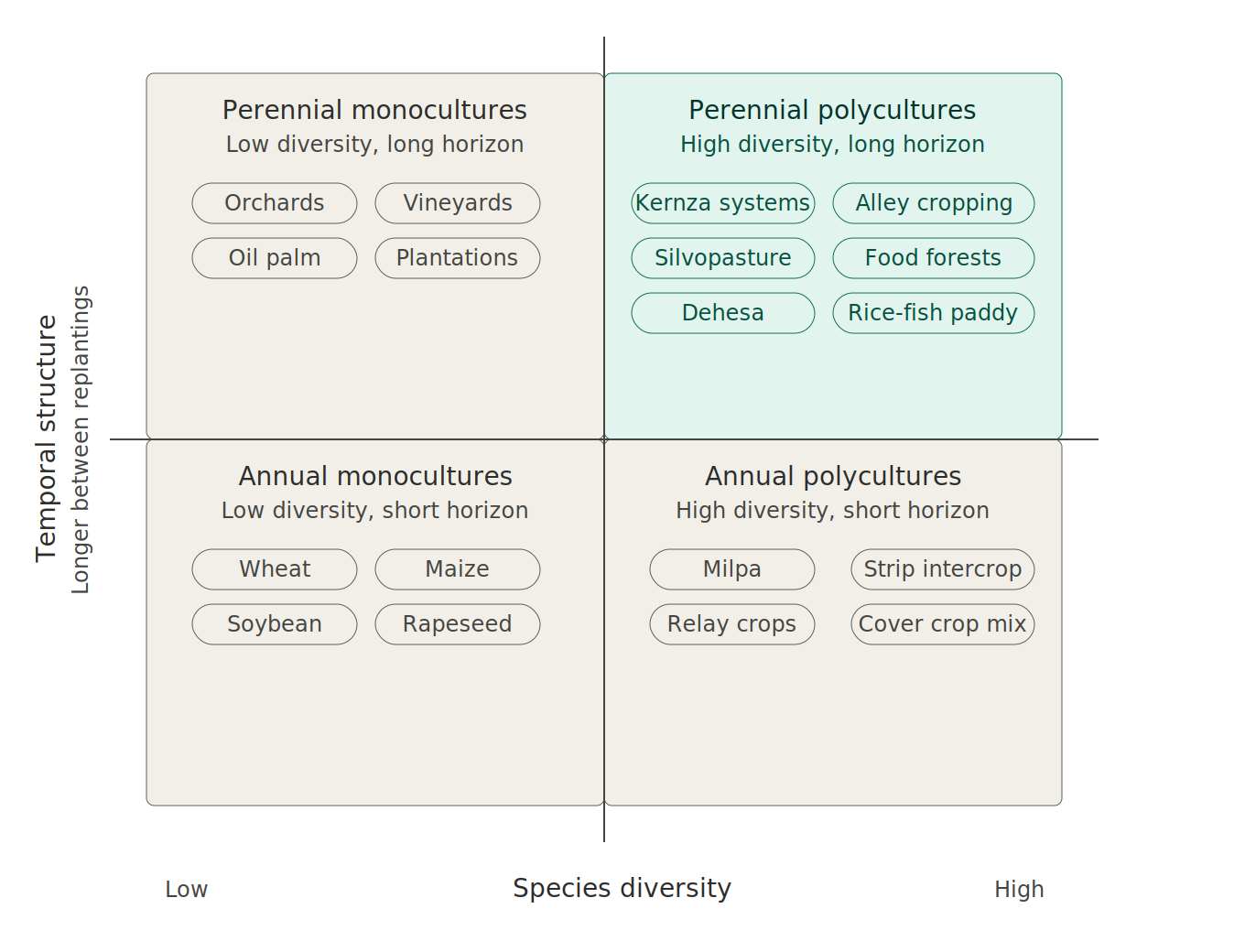
This mini-series focuses on the top-right quadrant, perennial polycultures.
Before starting the analysis, it is worth explaining why diversity and temporal structure matter in the first place.
The cost of replanting every year
Annual cropping — the dominant model for the cereals, legumes, and oilseeds that make up most of human caloric intake — requires that the ground be disturbed, the crop established, grown, and removed within a single season. In practice this means tillage, or chemical termination of the previous crop, and a period each year when the soil is bare.
The cumulative cost of that cycle is large and well-documented. Tillage breaks soil aggregates, accelerates the oxidation of soil organic carbon, and exposes fine particles to wind and water. Bare soil between crops loses nutrients to leaching and topsoil to erosion. Root biomass is minimal in annual systems — roots are shallow, short-lived, and removed with each harvest. This starves the soil microbial community, and the combined result shows up in soil structure, or rather in its absence. Estimates of global topsoil loss vary, but the direction is not contested: we are losing soil considerably faster than it forms, and annual tillage agriculture is the dominant mechanism.
Perennial systems do not eliminate these problems, but they change the arithmetic. Continuous living roots hold soil in place, feed microbial communities year-round, and build rather than deplete soil carbon on decadal timescales. The annual re-establishment cost — in fuel, seed, labour, and exposed soil — is paid once per decade rather than once per year.
The cost of growing one species
Monoculture is a design decision with predictable ecological consequences. A field of one species, grown at high density over large areas, is a concentrated resource for anything that eats, infects, or competes with that species. Pest populations build. Pathogens find abundant hosts and short dispersal distances. Weeds adapted to the specific conditions of that crop come to dominate. The defences are chemical, genetic, and agro-technical: pesticides, fungicides, resistant cultivars, crop rotation.
These defences typically work for some time but eventually run out of their “shelf life”. Pests evolve resistance to insecticides and to Bt traits. Pathogens overcome resistance genes. Weeds develop herbicide tolerance. The treadmill is real, and its economics are worsening as the rate of new chemistry and new resistance traits fails to keep pace with the rate of adaptation.
Polycultures — fields containing multiple species at the same time — interrupt this dynamic in several ways. Host plants are farther apart, so specialist pests disperse less efficiently. Non-host plants in between physically and chemically confuse host-finding behaviour. Natural enemies of pests find more stable habitat across a longer season. None of this eliminates pest pressure but it lowers the baseline.
Touring the quadrants
Annual monocultures are the dominant system globally, and they produce most of what the world eats. Wheat, maize, soybean, rice, rapeseed — one species, replanted yearly, fully mechanized, scaled to hundreds or thousands of hectares per farm. This is also the quadrant carrying the full combined cost described above: annual soil disturbance and the monoculture pest treadmill, running together.
Perennial monocultures — orchards, vineyards, oil palm, plantation forestry — solve half the problem. The soil is not annually tilled and the roots are continuous. The other half remains: a monoculture at scale is still a concentrated resource for pests and pathogens, and the examples are plentiful. Banana plantations collapsing under Panama disease. Olive groves in southern Europe under pressure from Xylella fastidiosa. Oil palm monocultures as reservoirs for their own specialist pests.
Annual polycultures can be traditional systems — the Mesoamerican milpa (maize, beans, squash grown together) is probably the most widely cited example. The modern annual polyculture systems are an active research and practice frontier: strip intercropping (maize-soybean, wheat-faba bean) in alternating machine-width strips; relay cropping that sows the second crop into the standing first before harvest; multi-species cover crop mixes of ten or more species between cash crops.
Perennial polycultures occupy the remaining quadrant — the one this mini-series is about. Multiple perennial species sharing a field, persisting year after year from the same root systems. This is the quadrant that addresses both costs simultaneously. It is also the quadrant that is hardest to mechanize, hardest to finance, and hardest to scale. Which is why it needs to be sliced further.
Dissecting the perennial polyculture systems
The first distinction is scale. Food forests — densely layered, species-rich perennial systems with overstorey, mid-storey, shrub, and ground layers — sit at one end. Ecologically rich, culturally compelling, and in many contexts productive at the scale of a household or small community. They are also, at any scale beyond the garden or smallholding, effectively ungovernable by machinery. The question naturally arises: is there a way to have perennial polycultures that are scalable, potentially profitable, and still gentle on soils and agro-ecosystems?
The second distinction is age. The top-right quadrant is inhabited both by ancient systems — the dehesa and montado of the Iberian Peninsula, agroforestry traditions of West Africa and South Asia, the rice-fish paddies of East Asia — and by modern systems designed in the past several decades, often drawing on the logic of the heritage systems but built for contemporary machinery and agronomy. Both are real. Both matter.
A note on process: see my AI Use Policy for how I work with AI in producing this website's content.